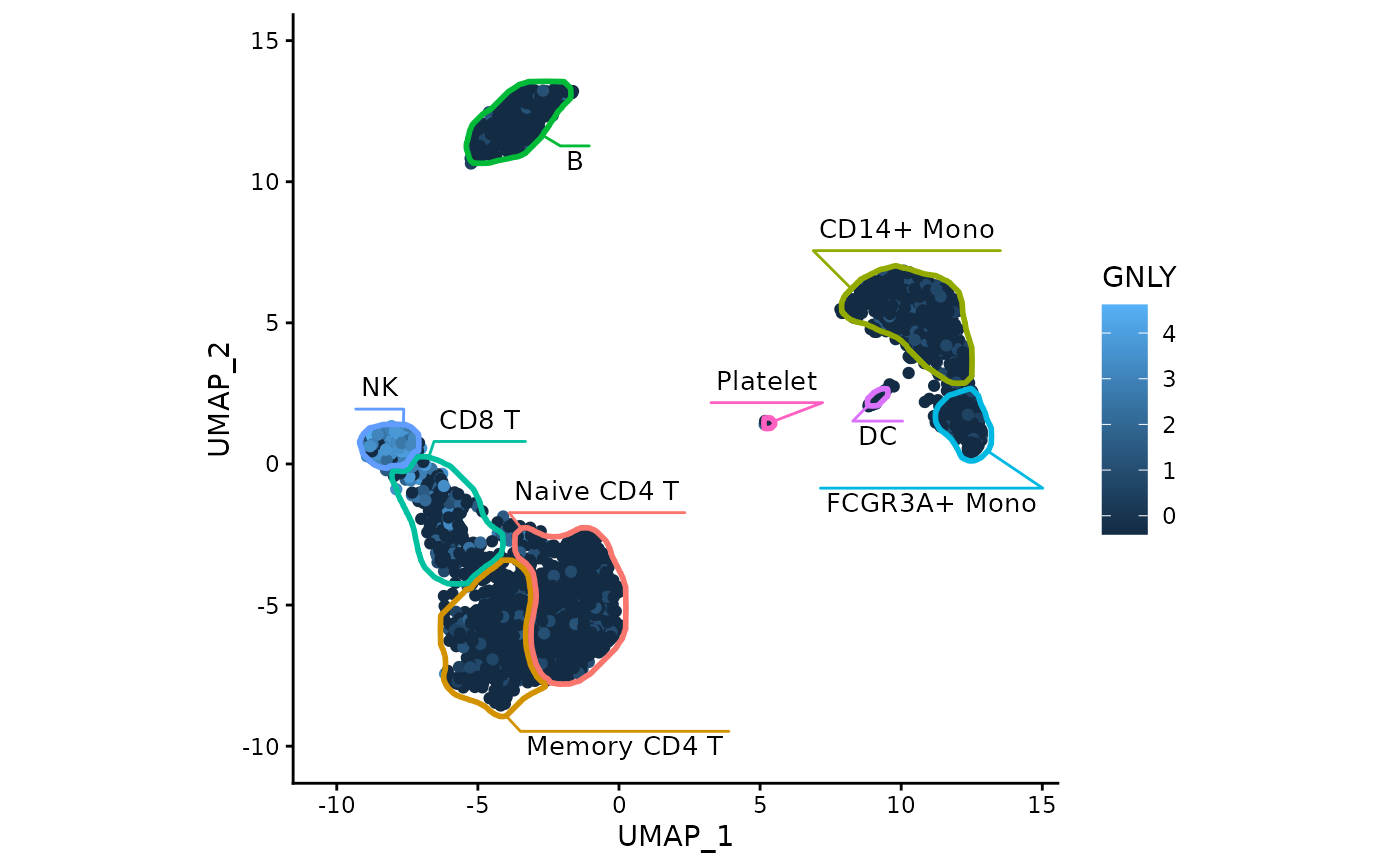
Convenience helper that returns a list of ggplot2 components
that draws polygon-like outlines and
places cluster labels.
The plotting limits are expanded (via limits.expand) to provide
extra room for labels.
Usage
fancyMask(
  maskTable,
  ratio = NULL,
  limits.expand = ifelse(label, 0.1, 0.05),
  linewidth = 1,
  shape.expand = linewidth * unit(-1, "pt"),
  cols = "auto",
  label = TRUE,
  label.largest = TRUE,
  label.fontsize = 10,
  label.buffer = unit(2, "mm"),
  label.hardpad = unit(0, "pt"),
  label.softpad = unit(6, "pt"),
  label.fontface = "plain",
  label.margin = margin(2, 2, 2, 2, "pt"),
  label.width = NULL,
  simp_ratio = 0.001,
  con.type = "ledge"
)
Arguments
- maskTable
A data.frame of mask coordinates. The first two columns are interpreted as x/y coordinates (in that order). Must contain at least the columns
cluster(a factor) andgroup(grouping identifier passed togeom_mark_shape()).- ratio
Optional aspect ratio passed to
ggplot2::coord_cartesian(). Use1for equal scaling. Default isNULL(no fixed ratio).- limits.expand
Numeric scalar giving the fraction of the x/y range to expand on both sides when setting plot limits. Default is
0.1with labels and 0.05 with no labels.- linewidth
Line width passed to
geom_mark_shape()for the outline. Default is1.- shape.expand
Expansion or contraction applied to the marked shapes, passed to
geom_mark_shape(expand = ...). Default isunit(-linewidth, "pt").- cols
Color specification for cluster outlines (and labels). One of:
"auto"(default) — inspects the plot at the timefancyMask()is added with+. If a layer mapscolourto a discrete (non-numeric) variable, the mask joins that scale viaaes(colour = cluster)so colours stay in sync regardless ofscale_color_*()order. Otherwise (continuous colour, constant colour, or no colour aesthetic) explicit colours fromscales::hue_pal()are baked in and the plot's scale system is left untouched."inherit"— always mapscolouras an aesthetic (aes(colour = cluster)), unconditionally joining whatever colour scale is present. Useful when you want to force scale sharing; will error if the existing scale is continuous.A palette function that accepts a single integer
nand returnsncolors (e.g.,scales::hue_pal(),rainbow).A single color string — applied to every cluster.
An unnamed character vector of length equal to the number of clusters — colors are assigned to clusters in factor-level order.
A named character vector — names must match cluster levels; order does not matter.
- label
Boolean flag whether the labels should be displayed.
- label.largest
Boolean flag. When
TRUE(default), only the largest part of each cluster is labelled; smaller disconnected parts are drawn but not labelled. WhenFALSE, all parts are labelled. Ignored whenlabel = FALSE.- label.fontsize
Label font size passed to
geom_mark_shape(). Default is10.- label.buffer
Polygon padding passed to
geom_mark_shape(): cluster polygons are dilated by this distance and labels are kept out of the dilated zone, so each label keeps a gap from its cluster outline. Defaultunit(2, "mm");unit(0, "mm")disables.- label.hardpad
Hard box clearance passed to
geom_mark_shape(): each label box is grown by this padding for all placement decisions, so labels keep at least this gap from each other. Defaultunit(0, "pt")(the label margin usually suffices; raise it mainly forcon.type = "box").- label.softpad
Extra box spacing the polish step aims for, on top of
label.hardpad, passed togeom_mark_shape(). Defaultunit(6, "pt").- label.fontface
Label font face passed to
geom_mark_shape(). Default is"plain".- label.margin
Label margin passed to
geom_mark_shape(). Default ismargin(2, 2, 2, 2, "pt").- label.width
Soft target width for wrapping labels, passed to
geom_mark_shape(). A grid unit (e.g.unit(30, "mm")); labels are balanced across lines to keep line widths even and close to this width, without a short dangling line.NULL(default) leaves labels unwrapped. Seegeom_mark_shape()for details.- simp_ratio
Fraction of the polygon bounding-box area used to simplify cluster polygons before label placement: small inward (concave) vertices whose cut-off area is below
simp_ratio * bbox_areaare removed, which speeds up the box-fit and leader-routing geometry (both scale with vertex count). The simplified polygon encloses the original, so labels never overlap the real cluster. Larger values simplify more; set to0to disable. Default0.001.- con.type
Leader / label-mark style passed to
geom_mark_shape(): one of"ledge","line","box", or"none"(see thegeom_mark_shape()Details). Default"ledge".
Value
A list of ggplot2 components suitable for adding to a plot with +,
containing a ggplot2::coord_cartesian() specification and a
geom_mark_shape() layer.
Details
The first two columns of maskTable are used as x/y coordinates. Cluster
labels are taken from maskTable$cluster. Shapes are grouped by
maskTable$group.
Examples
data("exampleMascarade")
maskTable <- generateMask(dims=exampleMascarade$dims,
                          clusters=exampleMascarade$clusters)
library(ggplot2)
basePlot <- ggplot(do.call(cbind, exampleMascarade)) +
    geom_point(aes(x=UMAP_1, y=UMAP_2, color=GNLY)) +
    scale_color_gradient2(low = "#404040", high="red") +
    theme_classic()

basePlot + fancyMask(maskTable, ratio=1, cols=scales::hue_pal())